01635 510500


Our aim is to teach our students how to present themselves with personal excellence and listen to others carefully to achieve collective responsibility. We aspire to build a culture of confident communication, both socially and academically, building upon mutually respectful student-teacher relationships, which we place at the heart of our school community.
Through our academic and belonging curriculum, students will be exposed to a variety of scenarios and audiences that move beyond the classroom through a broad range of exploratory and presentational talk. Teachers will model and facilitate context specific talk, and set up opportunities for all students to engage in these authentic contexts.
We have attached a year group oracy focus to each of our 7 curriculum years, to ensure the
oracy skills students acquire are built upon year on year. This is part of our combined vision that
students at Trinity are here for a 7-year learning journey, and that each year there are different
levels of challenge and opportunities.
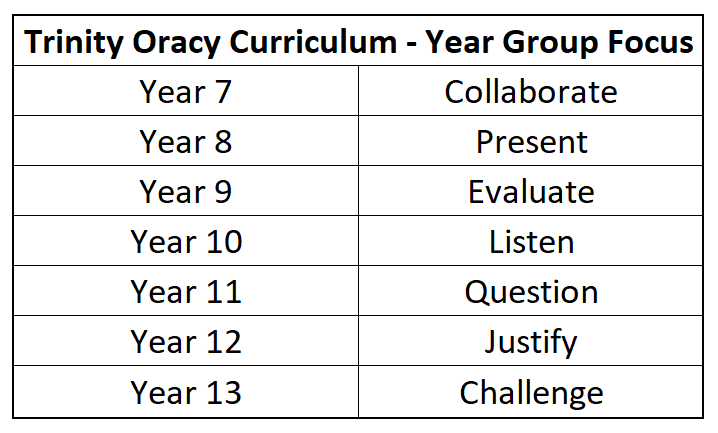
Within each year group focus, we have adapted the Voice 21 progression map to ensure that all
elements of the oracy framework are explicitly targeted. As such, each year group has an oracy
curriculum, based on the 4 key strands; physical, linguistic, cognitive, and social and emotional.
By the end of their 7-year journey, all Trinity students will have experienced every component of
the Voice 21 framework.
Using the Voice 21 framework, we have designed an oracy curriculum for each year group. Below, you can see the skills that students will focus on each year. These are also replicated in our Trinity Oracy assessment sheets
We are committed to ensuring all students interact whilst in school, and building on the belonging behaviours work in tutor times and PSHE sessions, this notion will form part of our day to day lessons across all disciplines.
Using our agreed shared strategies, where oracy opportunities are planned for in lessons they will follow one of the below formats:
Alongside this, staff will hold 'no hands up' lessons to ensure that where explicit oracy opportunities are not suitable to the curriculum content, that students will still expect to engage in communication.
All subject areas have produced a 'talk like a specialist' knowledge organiser, and these will support students in speaking appropriately for the discipline.
To support with consistency, we are utilising the noun project to dual code our expectations of students at any given time. These are centrally stored for all subject areas to use:
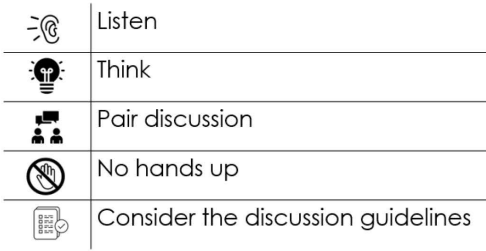
The second strand of our oracy curriculum is the explicit planned curriculum point. All subject areas oracy curriculum points will be delivered through a direct instruction lesson, ensuring that students are clear where day to day oracy becomes stipulated parts of the curriculum.
In every classroom at Trinity, students will see a copy of our Discussion Guidelines on the tutor belonging board. We hold students to consistently high expectations surrounding oracy skills, both speaking and listening, learning, and presenting, questioning and clarifying.
Every subject area has created a ‘talk like a specialist’ mat designed to support students with the disciplinary based language required in their subject area. The mats include:
- Subject specific vocabulary to inform talk
- Sentence starters to use in thinking, writing and speaking
- Prompts for thinking like a specialist
- Guidelines for speaking in a specialist setting
- An inspirational figure linked to the subject discipline.
Trinity is proud to offer a comprehensive range of extra-curricular opportunities for students across all year groups, with a wide range of these focused on essential speaking and listening skills. This is also supplemented by our vast array of House competitions, which encourage healthy competition between students!
Examples of opportunities for students are:
Students can access the school bulletin for further information on the full range of extra-curricular opportunities.
Trinity Talks Podcast
Trinity is also proud to host ‘Trinity Talks’, a student-led podcast new for 2026! To read about the podcast and listen to the series, please click here